Abandoned Cart Recovery Email Flows That Win Back 15%+ of Lost Sales
Every online store owner knows the feeling. A shopper browses your products, adds items to their cart, and then disappears without completing the purchase. It happens constantly—and it costs the e-commerce industry over $4 trillion in lost revenue each year. But here’s the good news: a well-crafted abandoned cart recovery email sequence can bring a significant portion of those shoppers back. When done right, the best email flows consistently recover 15% or more of abandoned carts. That’s not a small number — it’s the difference between a struggling store and a thriving one.
Why Shoppers Abandon Their Carts in the First Place
Before you can fix the problem, you need to understand it. Cart abandonment rarely happens because someone simply changed their mind. Research from the Baymard Institute consistently shows that the majority of shoppers abandon carts due to unexpected shipping costs, complicated checkout processes, or because they were never ready to buy in the first place — they were simply browsing or comparing prices.
This intent gap corresponds to how you should write your abandoned cart recovery email. You aren’t trying to connect with people who simply forgot. You are reaching out to people who hesitated. This change in perspective corresponds to how you should adjust your tone, timing, and offer. And of course, it drastically improves your results.
The Anatomy of a High-Converting Abandoned Cart Recovery Email Flow
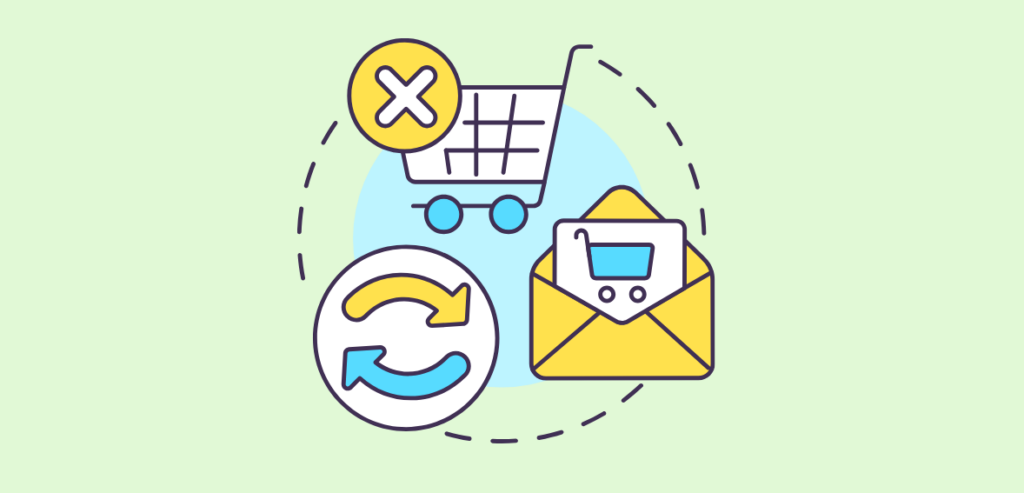
Most e-commerce brands that see strong recovery rates don’t rely on a single email. They build a strategic sequence — typically three emails sent across several days — each with a distinct purpose and tone.
Email One: The Friendly Reminder (Send at 1 Hour)
Your first email should go out approximately one hour after abandonment. At this stage, the shopper still remembers exactly what they were looking at. The goal here is not to pressure them. You’re simply reminding them that their cart is waiting. Keep the subject line personal and low-friction — something like “You left something behind” or “Still thinking it over?” works well because it mirrors how a helpful store associate might speak, not a marketing algorithm.
Be sure the email is organized and easy to read. Include just one product image, the product name, and the product price. The email includes the only CTA button that directs the client back to their included cart. The email does not include any discounts, no forced time restriction, etc. The email is a respectful, non-intrusive reminder. The email should assume the buyer has the product in question and has not made a final decision.
Email Two: The Value Reinforcer (Send at 24 Hours)
Including the second email in a cart session will bring you even closer to a conversion. There may be multiple reasons the initial cart session did not complete. This second email will encourage the potential buyer to provide the social proof you need, support the return policy, highlight free shipping (if offered), and address common objections. If someone is doing a cart session, they are interested in the product and simply need a nudge and a bit more confidence to complete the purchase.
Consider including customer reviews of the specific product they abandoned. A testimonial that says “I wasn’t sure at first, but this is now my favorite purchase this year” does more persuasive work than almost any marketing copy you could write. You’re letting your customers sell for you, which feels authentic because it is.
Email Three: The Incentive Closer (Send at 48–72 Hours)
This is your closer. By the time a shopper reaches 48 to 72 hours without converting, a gentle incentive can be the final push they need. A 10% discount code, free shipping, or a small gift with purchase are all effective here. But the framing matters enormously. Don’t just drop a coupon code into the email and call it a day. Present the offer as something exclusive and time-limited — “Here’s a little something just for you, but it expires in 24 hours” — and pair it with a light scarcity element tied to inventory levels if that’s genuinely true for your store.
Critically, this third email should also signal that this is the final follow-up. Something like “We don’t want to keep filling your inbox, so this is our last reminder” actually increases conversions because it removes the pressure of ongoing email bombardment and prompts an immediate decision.
Subject Line Strategy for Abandoned Cart Emails
A cart abandonment recovery email is only as powerful as its open rate. That also means the subject line is your most powerful tool. The subject lines that perform best tend to have a personal touch, create some intrigue, and avoid language that could trigger spam filters to flag a promotional email.
Phrases like “Did you forget something?” and “Your cart is about to expire” consistently outperform generic subject lines. First-name personalization — when your data is clean — lifts open rates meaningfully. Emoji can work, but they should be used sparingly and only when they match your brand voice. A luxury furniture brand and a playful streetwear label will have very different subject line strategies, and that’s exactly how it should be.
Personalization and Segmentation: The Hidden Multiplier
Generic abandoned cart recovery emails perform. Personalized, segmented ones perform dramatically better. Modern e-commerce platforms and email service providers give you the tools to tailor your flows based on the customer’s purchase history, the total cart value, and even the product category they abandoned.
Different abandonment messages should be sent to a first-time visitor who left a $30 product in their cart versus a loyal shopper who walked away from a $300 product. The first-time visitor is looking to build trust. The loyal shopper should be motivated to act now. This might include a personal loyalty bonus or an unexpected thank-you to reward the loyal shopper. Leaving the two customers treated the same means uncapitalized abandonment potential.
Klaviyo
Technically, Klaviyo is the best example of how an e-commerce marketing email platform should be. They have an abandoned cart flow builder that helps you create advanced flows with multiple steps, segmentation, dynamic product sections, and behavioral triggers. If you use Shopify, WooCommerce, or BigCommerce, your cart data will sync in real time, so there will be no need for manual intervention when your flow is fired. If you actually want to make back the money you lost, you’ll learn the Klaviyo flow builder because the time to mastery is very short, and the flow is very important too.
Timing, Frequency, and Deliverability
Timing is everything in abandoned cart recovery. Send too early, and you may interrupt a shopper who simply stepped away for five minutes. Send too late and the moment has passed. The one-hour, 24-hour, and 48-to-72-hour cadence represents the sweet spot that most high-performing e-commerce brands have converged on through extensive testing.
Deliverability is the other, less flashy, half of the game. An attempted abandoned cart email that ends up in the email promotions tab or the spam folder might as well not exist. To maintain your sender reputation, use a unique sending domain, avoid emailing unengaged recipients, and always provide a visible unsubscribe link. It is not negotiable to get your funnels to work at a large scale.
Beyond Email: Integrating SMS Into Your Recovery Flow
Email remains the backbone of abandoned cart recovery, but SMS has emerged as a powerful complement. Response rates for text messages are significantly higher than email in many demographics, and a brief, permission-based text sent a few hours after abandonment — combined with your email sequence — can push your recovery rate well beyond the 15% threshold.
The most important word here is permission. Retailers are only allowed to send promotional SMS campaigns to clients who “opt in” to receive those messages. Sending promotional SMS campaigns to clients who haven’t “opted in” is not only illegal in most jurisdictions (including under TCPA regulations) but far more damaging to a retail brand’s image. When SMS campaigns are done correctly, they keep brands in real-time connection with their clients in a way that email campaigns cannot.
Klaviyo and other email service providers offer useful guides and benchmark data to help integrate email and SMS marketing effectively.
Measuring What Matters: KPIs for Your Abandoned Cart Flow
Tracking the proper metrics helps you know if your flow is working. Open rate tracks whether your subject lines are resonating with customers. Click-through rate tracks if your email content and design are drawing customers in. However, the most important metric is recovered revenue. This is the dollar value of orders customers completed after interacting with your recovery flow.
Most platforms display this as “flow revenue” or “attributed revenue.” Treat anything above a 10% recovery rate as a solid baseline. Flows optimized with personalization, strong copy, and a well-timed incentive regularly hit 15% to 20%. Some highly optimized setups with SMS integration push past that. Track these numbers monthly, run A/B tests on subject lines and incentive amounts, and treat your abandoned cart flow as a living asset — not a one-time setup.
Conclusion
Cart abandonment is not a failure. It’s an opportunity. Every shopper who left without buying still raised their hand and said they were interested. Your abandoned cart recovery email flow is how you answer that signal with the right message at the right moment.
Building a three-part sequence — a friendly reminder, a value reinforcer, and an incentive closer — gives you a structured, respectful, and highly effective system for winning back lost sales. Layer in smart personalization, clean subject lines, strong deliverability practices, and optional SMS, and you have a recovery engine capable of generating consistent, measurable revenue on autopilot. Start with the fundamentals, test relentlessly, and let the data guide your refinements. The 15% recovery benchmark is absolutely achievable — and for many brands, it’s just the beginning.
Frequently Asked Questions
How soon should I send the first abandoned cart recovery email?
The first email should go out within one hour of abandonment. At this point, the shopper still clearly remembers the product, and the purchase decision is still fresh. Waiting longer significantly reduces the chance of recovery.
Should I always offer a discount in my abandoned cart emails?
Not in every email. Offering a discount too early trains shoppers to abandon carts on purpose, expecting a coupon. Reserve the incentive for the third and final email in your sequence, and frame it as a limited-time, one-time offer.
What is a good abandoned cart recovery rate?
A recovery rate of 10% is considered a solid baseline. A well-optimized abandoned cart recovery email flow, with personalization and SMS integration, can regularly achieve 15% to 20% or more.
Which platform is best for setting up abandoned cart email flows?
Klaviyo is the most widely used and recommended platform for e-commerce brands, especially those on Shopify. It offers native integrations, dynamic product blocks, and advanced segmentation, making it straightforward to build sophisticated recovery flows.